Ten Years of Snappic: The Nightclub Idea That Became a Photo Booth Platform
Explore how a failed nightclub idea grew into Snappic’s global photo booth platform and see how photo booth software evolved to power modern events

September 17, 2026
The Snappic team is passionate about creating unforgettable photo booth experiences.
Ten Years of Snappic: The Nightclub Idea That Became a Photo Booth Platform
Ten years ago, four people in South Africa tried to put photo booths in nightclubs. It didn't work.
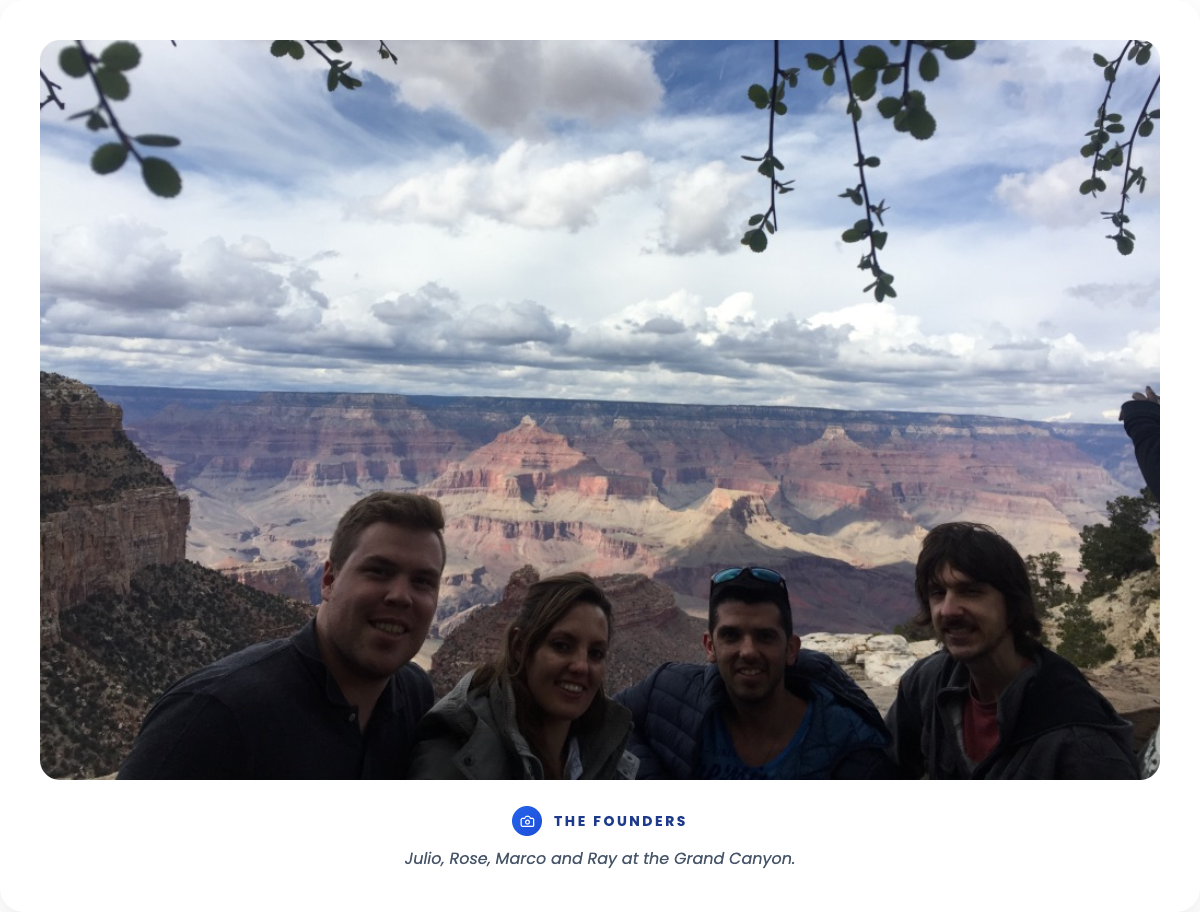
This month Snappic turns ten. There are now more than 9,000 operators running events on the platform in over 90 countries: weddings, corporate activations, brand launches, parties in cities all over the world. To mark it, we chatted to Snappic's founders — Julio Amorim, Rossella Amorim, Marco de Freitas and Rayman Rosevear — and went back through how it actually happened. Not the tidy version. The one with the failed pitch, the trade show where they couldn't take a photo, and the Saturday night that changed how the company handles support.
It started with an idea nobody wanted to pay for.
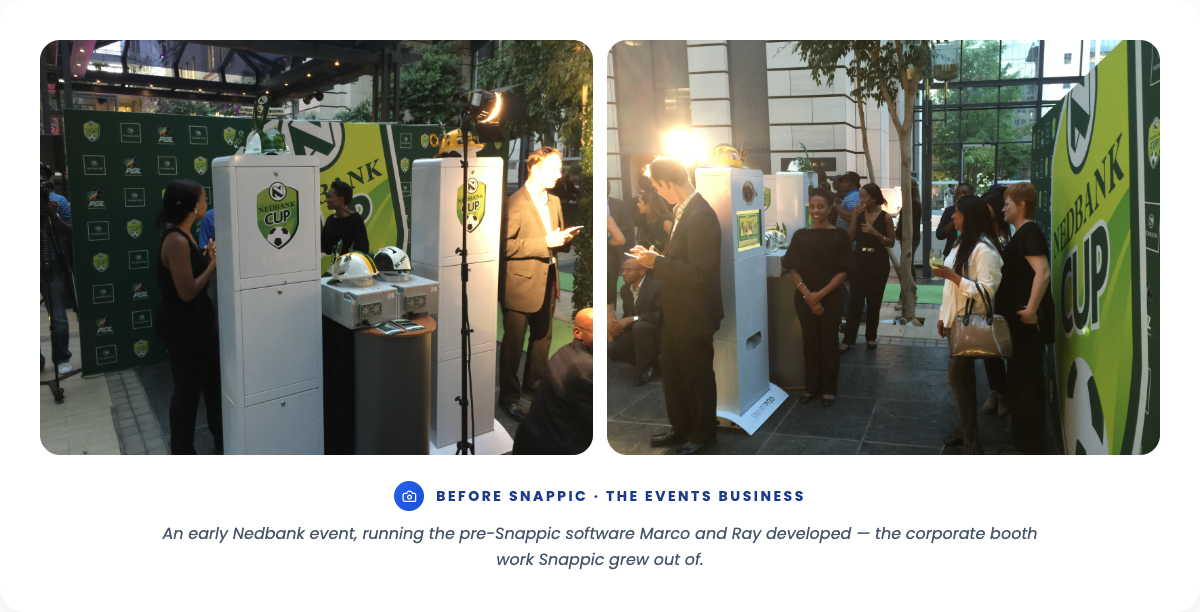
Before Snappic, Rose and Julio were running an events business in South Africa: photo booths and event registration for corporate clients. Ray and Marco had their own software development company. Julio and Marco had been at school together.
The first idea wasn't corporate at all. The big advertising screens you'd see in clubs elsewhere weren't a thing in South Africa yet, and they thought: put those screens in, but make them an experience. A photo booth built into the branding. Guests get something fun, sponsors get their logo in front of people. They had units shipped in from China, but needed someone to build the software.
Julio: "I'd actually built a photo booth with a friend back when we were still at school, so the idea wasn't coming from nowhere."
Ray: "Back then, Marco and I were charging people to make apps for them, and Julio wanted to give someone money to make an app. It was a perfect match."
So it didn't start as a partnership. It started as a job. Two people from events hired two developers they trusted, because one of them had sat next to the other in a classroom years earlier.
Then they tried to sell it. The clubs loved it — they just wanted it for free. You get the sponsor money, we get the screens. That idea died.
What didn't die was the hardware in the storeroom, or the belief that a photo experience could be a real business. By some miracle, Rose and Julio then landed an event for one of the big banks in South Africa, ran the booths there, and that one event pushed them into corporate photo booth work. That's the business Snappic grew out of.
The problem was Windows.
Honestly, that's the short answer.
In South Africa they didn't have access to the booth hardware operators were using in the States or Europe. The only software available to them ran on Windows. Anyone running a booth back then knows what happened next... You're setting up at an event and Windows decides it's time for a hundred updates.
Julio: "You're sitting in front of a tower saying 'five more minutes, we're just getting set up,' and thirty minutes later it's still going and the guests are arriving. We got to a point where we said: we can't do this anymore."
Rose: "Our whole business was riding on huge brands, and we had promised them a smooth experience. When the software let you down in front of a client like that, it was devastating."
At that time, the iPad was taking off, and they'd always loved Apple. What they wanted was the thing operators take for granted now: refresh the iPad, and you're in. Something goes wrong, close the app and open it again. Make a change online and it syncs to the booth. Everything queues offline.
Ask the developers and you get a more honest version, though — this was never really about capability.
Ray: "It wasn't that iOS made anything possible that we couldn't do on Windows. It was our passion for Apple and iOS devices, the form factor and ergonomics, and the reliability and developer experience that came with it."
That's the part that matters. A booth isn't a computer that happens to take photos. It's a thing an operator carries into a venue, sets up in twenty minutes, hands to strangers all night, and packs into a car at 1am. The device it runs on is the product. Choosing one that was light, predictable and didn't surprise you was the whole idea.
At the time, this was not the obvious call. iPad booths were being dismissed as a fad, and plenty of operators said the quality would never be good enough.
Julio: "We always say it was a calculated risk. Calculated because we knew what we had was a really stable platform with iOS and the iPad — and if this was going to be the evolution of photo booths, it was most likely going to be on the iPad. The camera gets better every year, the processing gets better. Which is exactly what happened."
When it stopped being a side project.
Most people don't know that the founders were building two platforms at once. Event registration was a big part of Rose and Julio's events business, so a registration platform was being built alongside the photo booth one. However they never got it to a point where they could sell it — companies in that space were raising fifteen million dollars, and there was no sense chasing that when they'd found a niche nobody was serving properly.
So they chose.
Ray: "Pretty much at that point we stopped working on the Windows software and decided to partner up and collaborate on Snappic."
Until then they'd been building what they were asked to build. From then on, the four of them were building what they all believed in — and the question changed from what does the client want to what does the operator need.
It wasn't only the business case that pulled them in.
Ray: "We always enjoyed working on different, more challenging problems. Most apps are just form submissions, API calls and database queries. Snappic exposed us to a lot of interesting technology — GPU-accelerated shaders, message queueing systems, low-level video codec details. It was something fresh, a welcome change of pace from the normal apps we worked on."
A photo booth sounds simple from the outside. Underneath it's real-time image processing, video encoding, print pipelines and a sync system that has to survive a dead network — running on a tablet, in a tent, at midnight.
What's actually hard about building for live events
You don't get to roll back a wedding.
In most software, a bug is a ticket. You ship a fix, users update, life goes on. In event software, a bug happens in a room with two hundred guests, a paid vendor and a client who will remember it forever. There's no staging environment for a Saturday night.
Ray: "One of the hardest problems is that the network, the camera and the printer are all unreliable — and the guest standing in front of the booth has about ten seconds of patience. Operators see a photo booth. What they don't see is that the app is really a queue manager holding a camera."
That's the job in one sentence. Three things that fail independently, one guest who won't wait, and software whose only purpose is to make sure none of that ever reaches the person in front of the lens.
It's also why they ship carefully. They've held features back because they weren't ready to be trusted at eleven at night, and they'd do it again.
The decision they're most glad about is one you can't point to in a feature list:
Ray: "We had a long-term vision for Snappic when we started building it, so we put a lot of effort into doing it right from the start. Because of that, the architecture of the app hasn't changed much — our early decisions have served us well and given us a great base to extend from."
That cost time in 2016 that a scrappier team would have spent shipping features. But ten years later, five booth types — iPad, 360, mirror, robot arm and roaming — all live on one platform instead of being four products stapled together. The foundation was built for a company, not a demo.
We brought a photo booth to a photo booth expo and couldn't take a photo
Ray: "This one was a doozy."
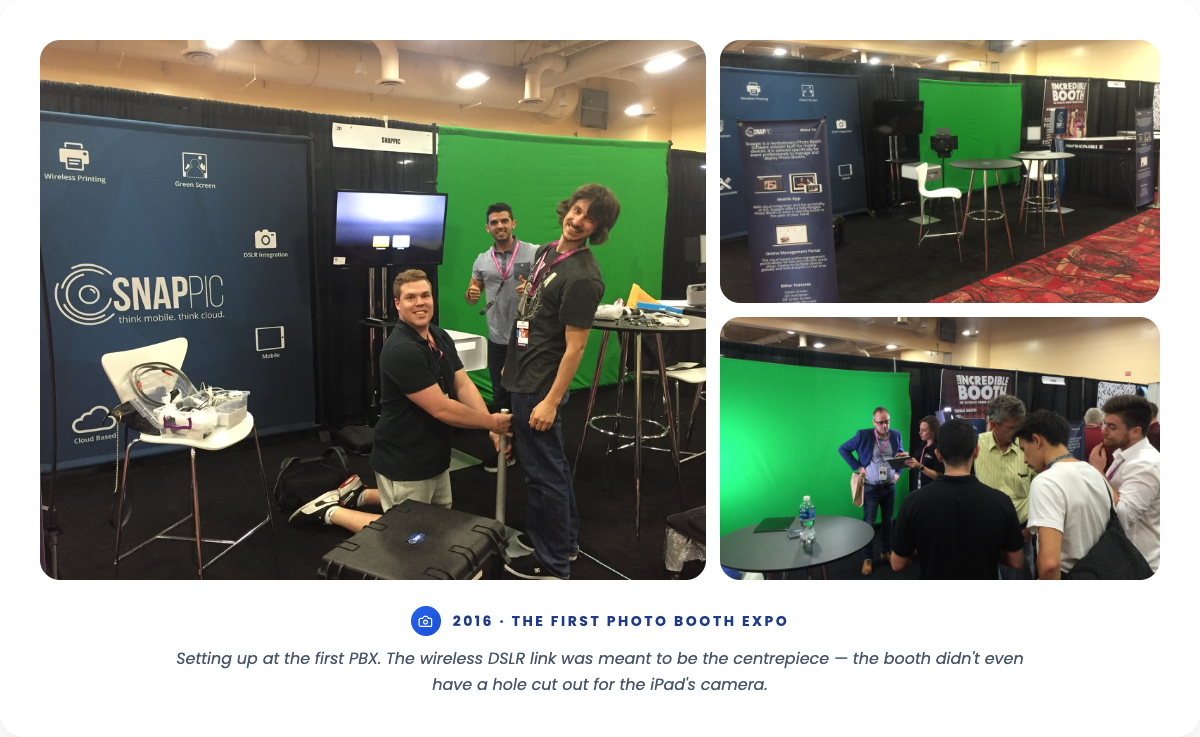
Some context. When the four founders started building Snappic, there were no other iPad booth apps... only Windows.
All of them supported DSLR cameras over USB, and they knew quality mattered to operators in the industry. But Apple didn't allow USB connections to DSLRs back then.
So the answer: connect to the DSLR wirelessly... what they believed was the first iPad-to-DSLR integration in the world. It was going to be the centrepiece of their stand at their first Photo Booth Expo.
They were so sure of it that they didn't plan for anything else.
Ray: "The app still worked with the built-in camera, but we didn't even consider using it — the DSLR took much higher quality pictures. So the booth we brought with us didn't even have a hole cut out for the iPad's camera."
Then the doors opened. Anyone who has exhibited at a convention centre knows what happens to a wireless signal when a few thousand phones walk in. The camera link got worse by the hour, and eventually the app couldn't connect at all.
Ray: "So we had a photo booth app to showcase, but no way to take any pictures and actually show people how it works."
Julio: "We were genuinely asking ourselves whether it was even worth being there."
They nearly packed up and went home early.
But they didn't. They stood at a stand with a booth that couldn't shoot and walked people through the app itself — the templates, the sharing, the speed, the way an event gets set up and changed in a few clicks. And the thing they'd treated as the supporting act turned out to be the product. People loved it anyway.
What worked wasn't a pitch about the iPad. It was a sentence about what operators were already living with.
Rose: "We're moving you away from the clunky, buggy, slow, unintuitive Windows experience — to something more scalable, that generates more revenue, quicker."
By the second day, people were arriving at the stand because someone else had sent them. Not compliments — operators are generous with those — but "someone told me I had to come see this" from people they'd never met. The founders think it landed because they weren't a software company demoing to operators. They were operators showing other operators the thing they'd built because they'd needed it themselves. People can tell the difference.
Two lessons were kept. Never rely on a venue's network, build so it works when the connection doesn't. And always have the simple version ready to go in case.
Ray: "If we had to do it all over again, we'd definitely at least have a camera hole cut out for the built-in camera. Just in case."
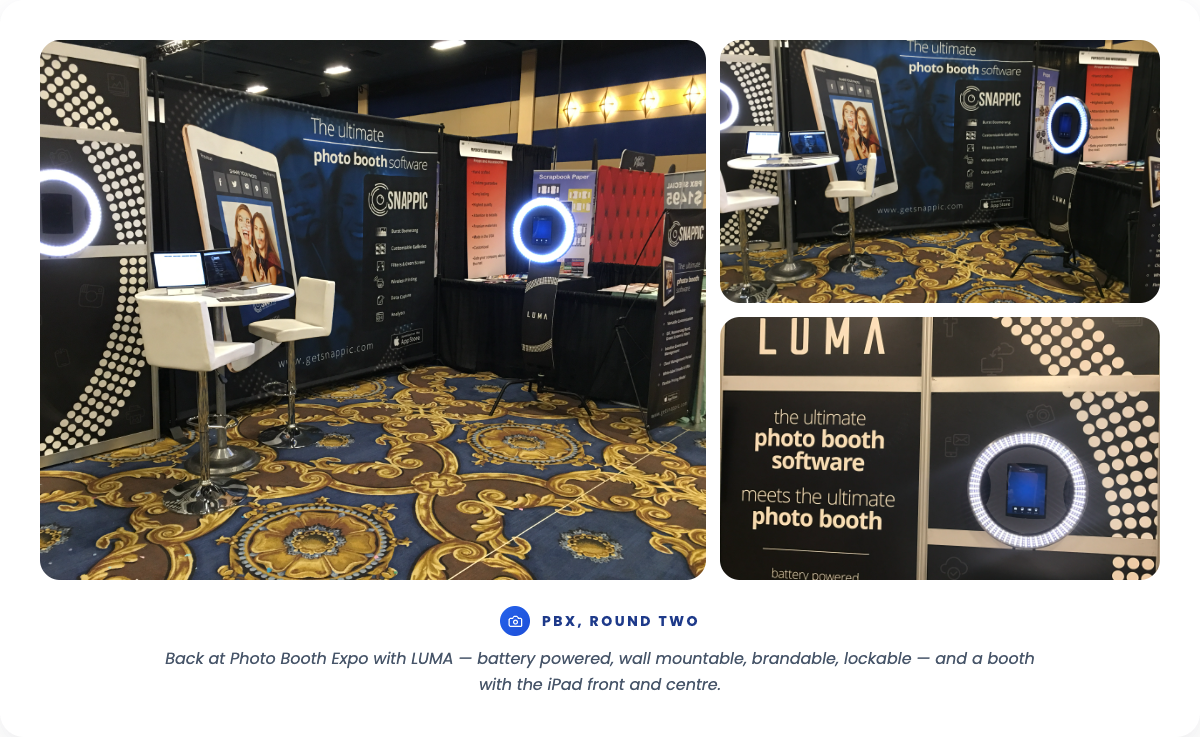
The operators who walked up to the stand
One of them was Social Playground — Polite Playground these days.
Rose: "One of our very first customers was Social Playground. We met them at our first PBX, and they've been an incredible partner since 2016. We've watched them grow into a seriously impressive business."
Ten years later they're still with Snappic, and the business they've built in that time speaks for itself. When we told them they'd be in this post, the first thing they asked was whether the founders ever expected to grow this big in ten years. The honest answer is no. They thought they'd give it a couple of years and see how it goes. And ten years later, here we are.
That's how this industry works, and it still surprises us. Operators talk. They're in the same groups, at the same shows, having the same problems on the same Saturday nights. One operator telling another that the software didn't let them down does more than any ad we've ever run.
Why we answer the phone at 11pm
By the second year, Snappic had 24/7 support. Not because the company had grown into it, but because it was a necessity to create a platform that focuses on reliability and ease of use.
Julio: "Support has always been my biggest frustration with the software we use every day, in the business and outside it. You need help, and there's nobody there. We made a point of being different: anyone who needs support, at any time, can get it."
Snappic's operators work when everyone else is off. Friday nights, Saturday nights, holidays, New Year's Eve. A software company that answers nine to five on weekdays is, structurally, unavailable to this entire industry at exactly the moments it's needed.
In 2018, that promise got tested.
In December, Snappic had a server outage. It was the hosting provider, not the platform itself, but that doesn't matter to an operator standing in a ballroom, and it shouldn't. It reflected on the company.
Julio: "I was sitting on the phone with people apologising, and it was really rough. These were big users we knew personally — we'd been at the show with them, we'd gone out to dinner with them — and we'd affected their business. That really hurt."
After that, the team moved the whole infrastructure to AWS and brought in someone to rebuild it properly. Uptime since has been the number the team is quietly proudest of. But what they took from 2018 wasn't that they needed support — they already had it. It was that support is only as good as the honesty behind it. Picking up the phone and apologising, personally, to people whose Saturday you've ruined is the part that can't be delegated.
Ten years in, support isn't just a department here. It's the promise.
What would have sounded impossible in 2016
AI-FX, for one. A guest steps into a booth and seconds later they're looking at a fully transformed image, running at a live event, on an iPad, reliably enough that operators sell it as a headline offering. The team would not have believed the timeline.
Ask the devs, and you get a less glamorous (but more practical) answer: plugging things in.
Ray: "The main things have always been what Apple locked down — third-party hardware like cameras and printers. I'd always hoped they'd open up direct USB support, because we've had a lot of workarounds over the years, each with their own drawbacks: print servers for printers, wireless connections, the Digital Director, USB proxy devices for DSLRs. Thankfully Apple have slowly opened things up."
Ten years of building a booth on a device that, for most of that time, wasn't allowed to talk directly to a camera or a printer. Every workaround on that list was a real product decision, a real support burden, and a real conversation with an operator about why their setup needed one more box. Those boxes disappearing is one of the quietest, biggest changes in the product's history.
But the thing the founders would most like to tell their 2016 selves isn't about a feature they've developed. It's the fact that Snappic has helped change people's lives for the better.
Julio: "We asked one of our clients 'are you going to be at PBX this year?', and they said no, we're actually in the Bahamas — thanks to Snappic. When a user tells us they started their business not making money and now they're doing six figures, that's incredible for us."
Ten years in, and still going strong
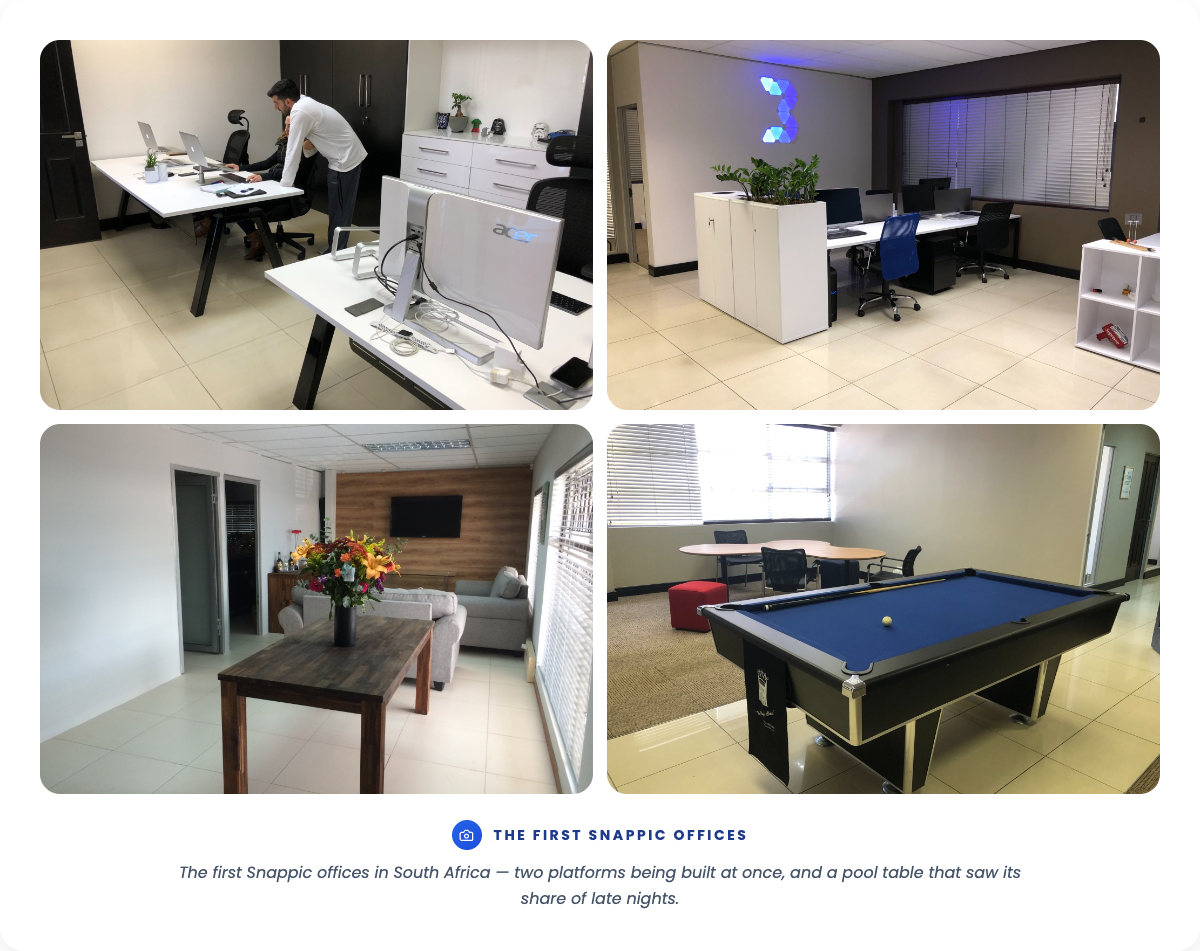
Julio: "We're still building for the person standing in a venue at 11pm. That there are 9,000 of them now is surreal. I'm just grateful we get to do it."
Rose: "A monumental shift in perspective. Insane highs and lows — but all in all, it's been an incredible decade."
Ray: “Ten years later, I still get a kick out of seeing something we built being used at an event on the other side of the world. I don’t think that’ll ever get old.”
Marco: "The big moments make the highlight reel, but the small ones make the business. As time goes on, the lows pass and the small wins compound."
Thank you
To every operator who took a chance on an iPad when the industry was calling it a fad. To the ones who called us at 11pm and gave us the chance to fix it. To the people who've been here since 2016, and to the ones who ran their first event last weekend.
You built businesses on software four friends started as a nightclub idea that didn't work. We don't take that lightly.
Here's to the next ten.