Ten Years of Snappic Support: The People Behind the Chat
See how a decade of Snappic support powers photo booth operators with real 24/7 customer support, expert tips, and smoother photo booth experiences

September 23, 2026
The Snappic team is passionate about creating unforgettable photo booth experiences.
Ten Years of Snappic Support: The People Behind the Chat
There are a few things that have changed dramatically at Snappic over the last ten years. The platform is bigger, the events are more ambitious, and operators are now creating experiences with AI, VideoFX, roaming photography and custom microsites that would have been difficult to imagine when Snappic first launched.
Then there are some things that are remarkably familiar.
Ask Nicholas Manuel what operators needed help with when he joined Snappic in 2017 and he’ll tell you that printing was one of the biggest issues. Ask Damir Ilieski what customers still occasionally need help with just before an event starts today and, well, apparently it’s still printing.
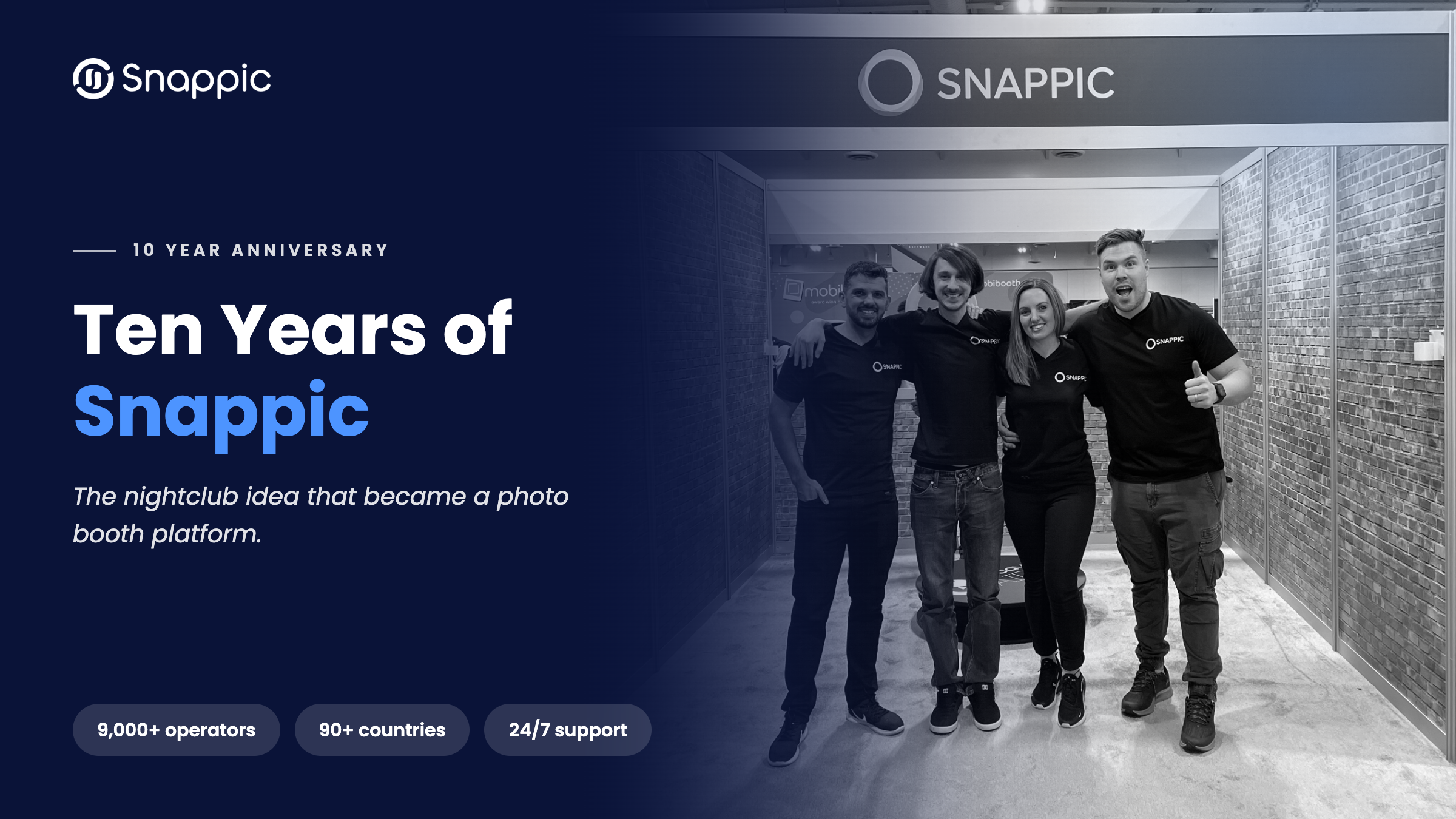
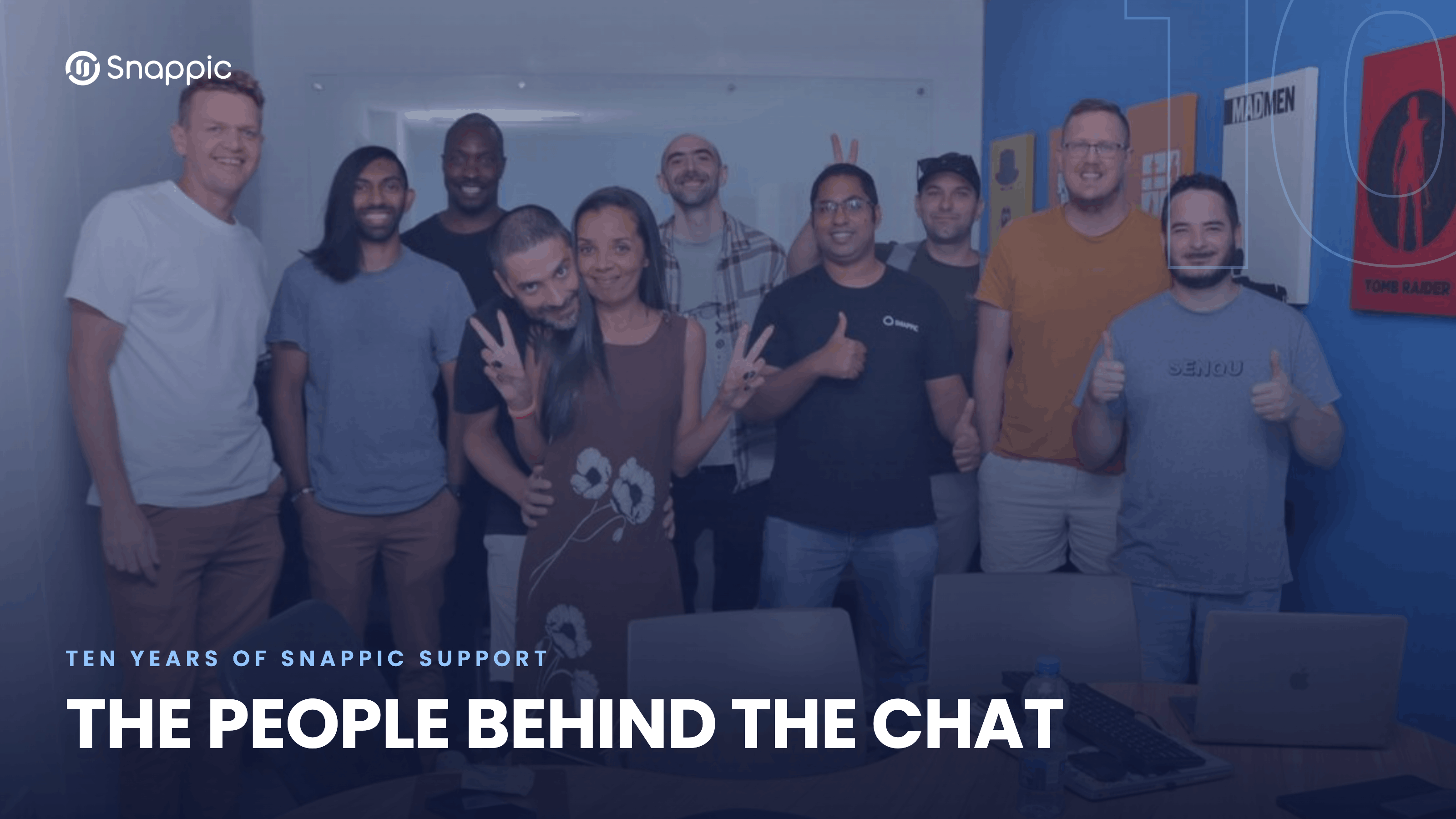
Over the years, the Snappic support team has gone from the four founders answering chats themselves to a 24/7 operation supporting thousands of operators around the world. Along the way, the people behind those conversations have watched Snappic grow, watched customers build businesses around it, and learned a lot about what it actually takes to support software that people rely on at live events.
For Snappic’s tenth birthday, we asked some of the people who have been part of that journey to look back.
From four founders to Snappic’s first support hire
When Nicholas Manuel, now Snappic’s Senior Customer Support and Success Operations Manager, joined on 1 December 2017, the company looked very different.
“It was a lovely little office, and the first people I saw when I walked in were the four founders,” he remembers. “The office was colourful and lively, and almost all of our clients were newbies at that time. I think I was the first Support team hire, as when I started, it was only myself in the office and the owners. I was very excited and optimistic.”
Nic also made a memorable first impression of his own.
“I walked into the office, suit and tie, and I was the only one dressed so formally,” he says. “Rossella showed me the way. Her guidance has been key from the start, and from there I would also work directly with all four owners as they taught me Snappic.”
His first day involved being handed a laptop and working his way through every Snappic help article he could find. He tested the platform, used an iPad for the first time and was soon jumping onto support chats to get comfortable speaking to customers.
December wasn’t exactly a quiet month to start.
“The owners of the business also used to jump on the chat to assist and teach me. The energy in the room was one of optimism and ambition. You could feel that Snappic was going to be something big.”
At that point, support was still deeply intertwined with the founders themselves. If a customer needed help, whoever could help would get involved. As the customer base grew, that approach had to become more structured, but Nic says the underlying goal was already there.
“The customer comes first, and our goal was to get you across the finish line and comfortable using the app. If you had issues, we were there for you. Our goal hasn’t changed in that regard. As our client base grew, we stuck to our core and just made sure we could help clients as they scaled up.”
And yes, there were printer problems
Some of the questions operators asked in those early days were understandably basic. Snappic was new, many of its customers were new to the platform, and tools that make designing photo booth experiences easier today weren’t nearly as accessible.
“Clients always needed help finding and understanding functions, like how to upload a template and create a custom overlay,” Nic says. “Back then, not many knew how to create these on their own. I don’t remember Canva being fully used as yet, and there weren’t as many graphic specialists as there are now.”
But one particular problem has followed support through almost every era of Snappic: printing.
“It was always easy to test printing in the week, but as the events approached and pressure ramped up, that’s where clients really needed us to help,” Nic says. “When you are live at an event, simple printing setups can be easily overlooked.”
He remembers plenty of high-pressure situations with customers in line and an operator trying desperately to get everything working before somebody important reached the front.
“Sometimes it would be a massive event, clients in line, and the bride waiting for her photo booth to work. There were many high-pressure moments which we would resolve using TeamViewer and guiding the client through that very stressful situation. Back then, printing was king.”
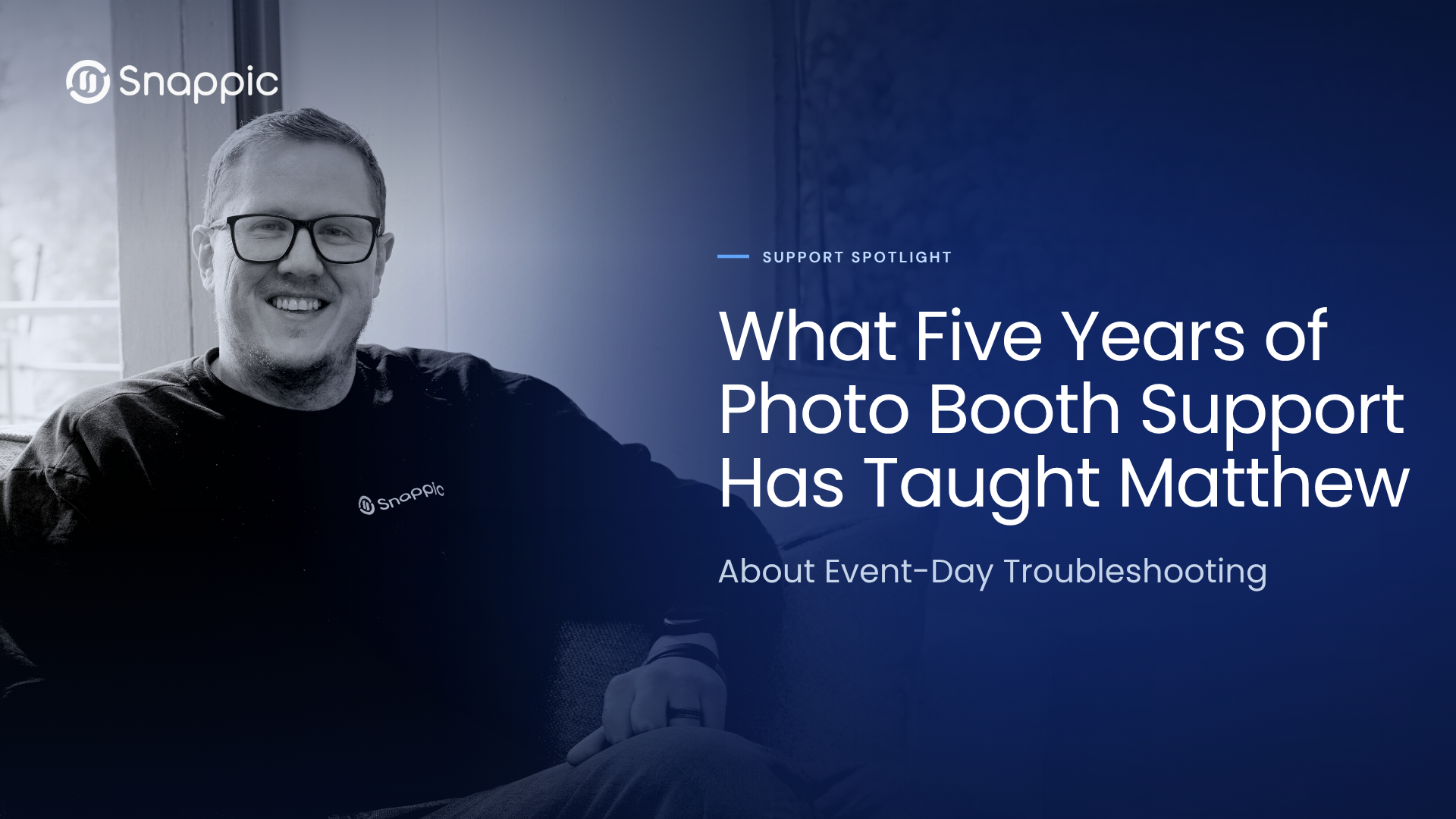
Damir Ilieski, now Snappic’s Senior Technical Support Manager, joined at the end of 2018. When asked what kinds of problems operators were asking for help with at the time, his answer was considerably shorter.
“I don’t think this has changed a lot. It was printing from the beginning.”
One of his first memorable support wins came from exactly that kind of situation, when he realised Windows could be used as a hotspot to get around unreliable venue WiFi and keep the printing setup running.
Years later, when asked what has remained surprisingly consistent despite all the growth, Damir gave much the same answer.
“Clients are asking us to help them with printing or uploading overlays just before the event starts. Fun times.”
There is at least some hope on the printing front. Two members of Snappic’s current support team, looking at the product from very different points in their time at the company, both singled out Direct Printing as one of the newer developments they’re most excited about.
Herman Killian, Senior Customer Support Associate, is one of Snappic’s longer-serving current support team members and has seen the platform become steadily more capable over the years. For him, Direct Printing is exciting because of what it removes from an operator’s setup.
“The setup will not require a computer to be at the event, allowing much more flexibility and less to set up.”
Thiroshan “Thio” Dhario Naidoo, Senior Customer Support Coordinator, is one of the newer members of the support team and came into a very different version of Snappic from the one Nic and Damir first learned. He picked the same feature.
“I know a lot of our clients were looking forward to this feature,” Thio says. “It makes it easier for our clients to manage their printing, and means that there is one less piece of equipment that they need to carry with to their event.”
The printer may not be leaving the photo booth industry any time soon, but at least there are fewer things between the iPad and the print than there used to be.
When one person could no longer handle a Saturday night
Damir remembers Snappic becoming a much bigger operation when “one person couldn’t handle an evening shift on a Saturday.”
Nic remembers it happening almost overnight.
“The chat volume started getting extremely busy. It tripled, what felt like almost overnight, with back-to-back conversations coming in non-stop. By the end of 2018, when Black Friday hit, it grew even more.”
By the end of that year, the support team had grown to four, and it kept growing as more operators joined Snappic.
The hours grew too. Before Snappic had full 24/7 support, Nic remembers regularly working until the early hours of the morning and staying longer if he knew someone still needed help.
“Even though I would finish at 2am, I would stay an extra hour or two if there were chat queries that came through and I was still around. We didn’t have to, but we did it as we wanted to be there for our clients as best we could.”
That willingness to stay online wasn’t just about providing unusually good customer service. It came from understanding the business Snappic’s customers were in. Operators don’t only need software during working hours. They need it at weddings on Saturday nights, brand activations after office hours and events happening across different time zones.
As Nic puts it, “There was nothing better than seeing a client go from newbie, to successfully running an event and growing their business.”
That idea became something of a mantra for the team: Your success is our success.
As Snappic changed, the questions changed with it
By the time Leslie Ilieski, now Snappic’s Customer Support Manager, began training at the end of 2021, customers were already asking about a very different platform.
“One of the things users were keen on trying was AI segmentation on VideoFX, as it was released shortly after I started, so we had to guide them in using this awesome new addition.”
The technology kept moving from there, and Herman has had a front-row seat to that change. As one of the longer-serving members of the current support team, he has had to keep learning as Snappic added entirely new kinds of experiences.
“I love the challenge of learning new things, including some great examples like AI-FX, VideoFX, Virtual Booths, AI Video, new ways to create and customise Microsites, email templates and more. There is always something new to test and learn in Snappic.”
He has also seen the scale of customer events become much more ambitious. One activation that stayed with him used two roamers and two stationary booths at the same time, drawing on a wide range of Snappic’s Business features across a single event.
“This event really showed me that users can make any event a huge success.”
Thio, coming into the team more recently, had a slightly different first impression. What surprised him wasn’t only the software, but the scale of the photo booth industry itself and how much work sits behind the experiences guests eventually see.
“What surprised me the most was how big the photo booth industry actually is, and how much effort goes into creating an amazing experience for their clients and guests.”
He is now seeing customers push some of Snappic’s newest tools far beyond the obvious use cases.
“What has impressed me the most is seeing some of our clients work with Microsite 2.0 and AI Video, and how far they have pushed the boundaries of what is possible, creating some truly unique experiences.”
The questions Support handles have inevitably become more sophisticated as the product has grown. What hasn’t really changed is the situation on the other side of the chat. There is still an operator trying to make an event work, usually with a deadline that isn’t moving.
Thio says those are often the conversations he enjoys most.
“I enjoy solving problems where a customer feels stuck or frustrated, and turning that into a positive experience. There is nothing better than finding a solution and getting them confidently back on track.”
Growing the team without losing the way it works
As the support department became larger, the way it operated naturally changed too.
Leslie remembers that when she started, management would review and close support conversations. Today, individual team members take far more responsibility for their own chats, while managers and technical staff are there to step in when needed.
“A number of things have changed, process-wise, as we have grown,” she says. “Now the team is more accountable for their own chats. They reach out to either the Manager or Technical Manager when stuck, to review the conversation and check if it’s ready to be resolved.”
Her own career followed that growth. Leslie started in Support, spent time running demo calls herself and eventually became Customer Support Manager.
“In leaps and bounds,” is how she describes her growth at Snappic. “Managing a team that has grown so much and setting them up for success in becoming a high-performance team has been my greatest challenge, as well as my greatest reward.”
Nic’s journey is even more closely tied to the department’s history. He went from being the first dedicated support hire to Support Team Manager, later took on Success as well, and today serves as Senior Customer Support and Success Operations Manager.
Along the way, he also helped bring Damir into the team.
“I have found my best years at Snappic, starting from the ground up and eventually becoming the Support Team Manager,” Nic says. “From there, I took on the Success department as well, merging the two and ultimately becoming the Senior Operations Manager for Success and Support, which has truly been the highlight of my time at Snappic.”
Damir’s own progression eventually led him into the role of Senior Technical Support Manager, but he describes the process less in terms of promotions and more in terms of figuring out where he was strongest.
“I have been very blessed here and appreciated the team noticing things I didn’t notice about myself,” he says. “Once I realised this, I managed to concentrate on what I enjoyed doing.”
The roles changed as the company grew, but Leslie believes something important stayed consistent.
“Company culture. Support culture, that started from when Rossella was still on support.”
What customers don't always see
From the outside, a support interaction can look fairly simple. A customer raises a problem, somebody responds, and eventually the conversation is closed.
Inside Snappic, those issues often travel much further.
Customers may not always realise how often feedback, pain points and recurring questions are discussed across the company. There are conversations around what can realistically be improved, which problems should be prioritised, what would have the biggest impact for customers, and how those changes fit into the workload of a relatively small team.
Not every suggestion can become a feature straight away, but that doesn’t mean it disappears.
As one of the newer people coming into that environment, Thio says this is something he has come to appreciate about the team.
“The team genuinely cares about how we can make things simpler, faster, more reliable, and ultimately more valuable for our customers so that they can run their events smoothly and successfully.”
He also noticed how willing people were to help outside the boundaries of their own roles.
“I would describe the culture as supportive, collaborative, and genuinely people-focused. Everyone is willing to jump in and help, regardless of their role. It is also a fun environment where you can be yourself, share ideas, and know that your voice is valued.”
Longer-serving members of the team helped reinforce that approach.
“They have taught me the value of patience, adaptability, and always putting the customer first. They have also shown me that there’s often more than one way to solve a problem, and that experience comes from being willing to learn from every situation.”
Herman’s experience over a longer period leads him to a similar description.
“Honestly, the ‘family’ feeling that the team has with each other,” he says. “I feel that the team as a whole is always pushing to reach even greater heights, making Snappic better and better at each opportunity.”
The same answer, years apart
Perhaps the most interesting thing about speaking to people who joined Snappic at very different points in its history is how often they return to the same idea.
Nic remembers the founders caring first and foremost about helping customers succeed.
“The number one priority was the success of our clients, teaching them how to use Snappic and resolving any issues they had so they could run a smooth event without any hiccups. We have always put the customer first. It has just evolved to doing it on a bigger scale.”
Damir remembers the same approach.
“They cared about helping them and teaching them,” he says, before adding one very Snappic-specific detail: “and also making sure we had the right spelling and grammar.”
Leslie talks about relationship building and loyalty to customers being part of the culture from the beginning.
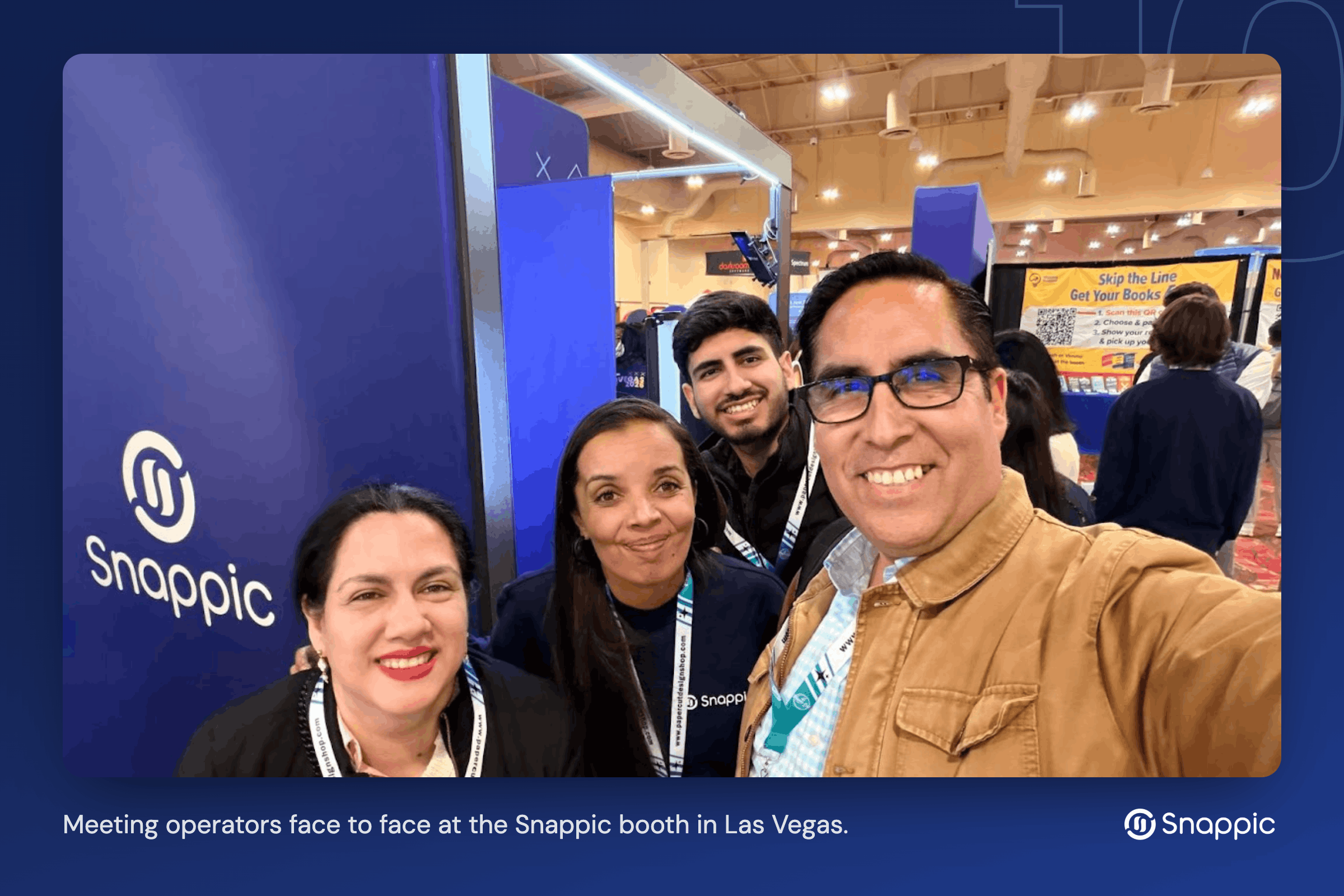
Years later, Thio describes excellent Snappic support in almost exactly the same spirit.
“To me, excellent support at Snappic means being approachable, proactive, and focused on finding the best solution. It is about understanding what the customer needs and making sure they feel confident and supported throughout.”
He believes that relationship is also what makes Snappic feel different from an ordinary software company.
“We are not just focused on building software, we are focused on building genuine relationships with the people who use it.”
For a company that has changed so much in ten years, there is something reassuring about how little that answer has changed.
Ten years of watching customers grow
Ask the longer-serving members of the team which customers they remember, and the names start coming quickly.
Nic remembers Nicholas Rhodes, PopSocial, Jessie Whitfield from MisGif, Andrew from BoogieBooths and Ryan Salinas among many others.
“I can list so many more,” he says. “There was more than one client that stood out, all so unique, but with a shared goal.”
Leslie remembers Nicholas Rhodes too, particularly because when she joined he already knew the platform so well that he understood much of the troubleshooting himself.
For the team, watching operators go from learning Snappic to pushing it in directions they hadn't necessarily expected is part of the reward.
Thio says joining Snappic changed his view of photo booth operators completely.
“I have learned that photo booth operators are incredibly adaptable and often juggle a lot behind the scenes. They are problem-solvers who care deeply about creating seamless, memorable experiences for their clients.”
That perspective is easy to lose when all you see is a support ticket. Behind the question about a printer, an overlay or an AI experience is somebody trying to deliver something they have promised to their own customer.
That is ultimately why the support team cares so much about getting them back on track.
As Nic puts it, “There was nothing better than seeing a client go from newbie to successfully running an event and growing their business.”
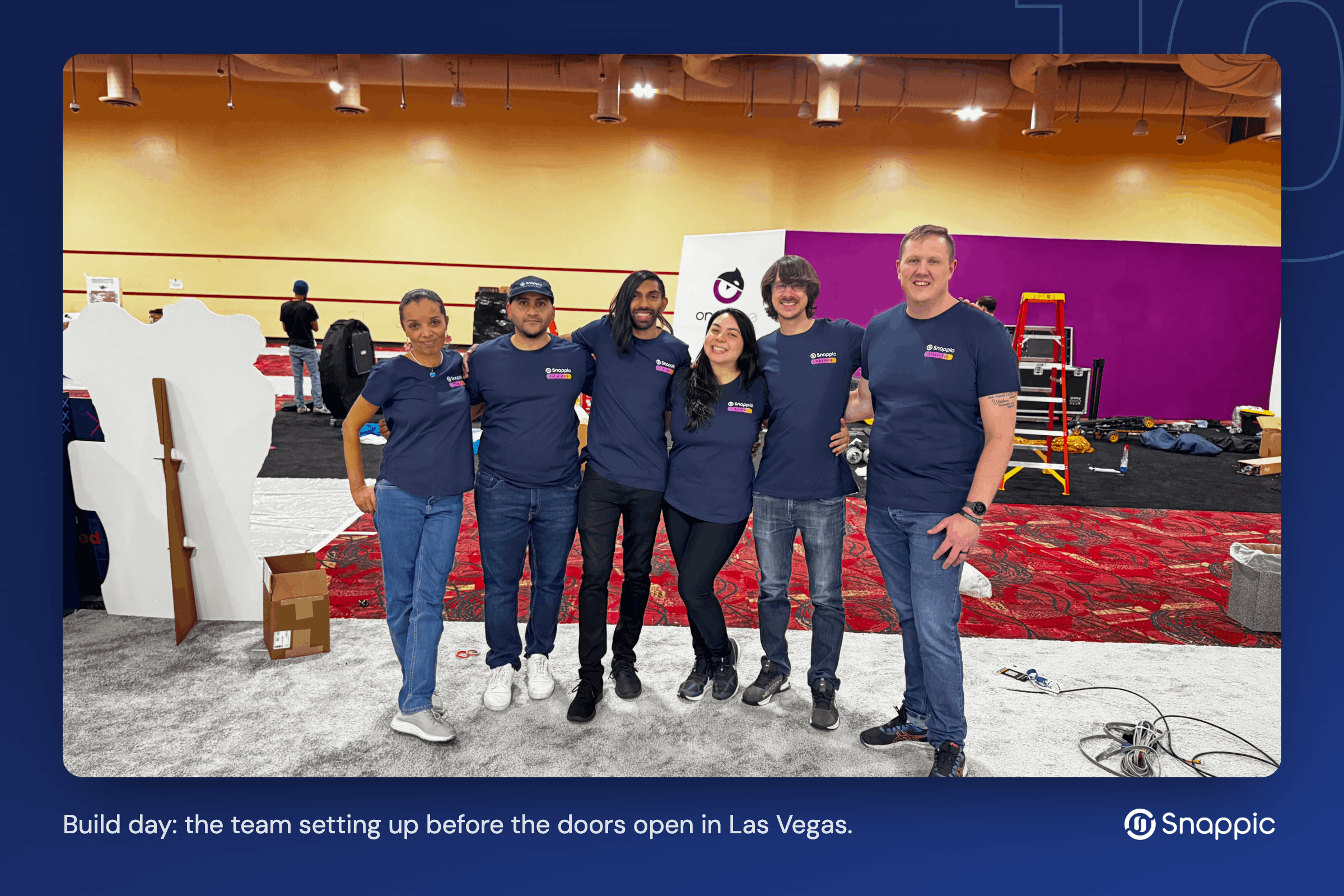
To the operators who got Snappic here
When asked what they would say to the customers who helped Snappic reach ten years, the answers were unsurprisingly similar.
Thio says, “Thank you for being part of our journey. Reaching this milestone wouldn’t have been possible without the trust you’ve placed in us, the support you’ve shown us, and your belief in what we’re building together.”
Nic’s answer comes back to the phrase that has followed him through most of his time at Snappic.
“Firstly, thank you! Without you, we would not be here today. Your drive has been our drive, your success has been our success. I look forward to seeing our clients grow from newcomers to the industry or the app into thriving, successful entrepreneurs as we evolve with the photo booth industry.”
Ten years later, the support operation is almost unrecognisable from the colourful little office Nic walked into in a suit and tie. There are more people, more processes, more products to learn and a much bigger community to support.
But if you ask the people who have been there at different points along the way what the job is really about, the answer is still fairly simple: help people get their events running, make sure they know someone is there when they need them, and give them the confidence to keep building.
Even if the message comes in five minutes before the event because the printer has suddenly decided not to cooperate.