2026 Photo Booth Playbook: What to Double Down On
Stop coasting into 2026. Uncover photo booth business trends 2026, pricing strategy, upsells, and automations to grow profit while working smarter.

January 26, 2026
The Snappic team is passionate about creating unforgettable photo booth experiences.
The 2026 Photo Booth Business Playbook: What to Stop Doing and What to Double Down On
Most photo booth businesses heading into 2026 aren’t struggling. They’re booked, they’re busy, and on the surface, things are working.
But beneath that, something has shifted.
Clients are more informed than they were a few years ago. Guests are more impatient. Expectations around speed, sharing, and overall experience have crept up steadily, even if the way many photo booth businesses operate hasn’t changed at the same pace.
This is why 2026 feels like a turning point. Not because of one big industry disruption, but because the gap between businesses that feel modern and those that feel dated is becoming more obvious.
“The industry didn’t change overnight. Expectations just kept rising.”
This playbook isn’t about chasing trends or overhauling everything you do. It’s about recognising which habits quietly hold businesses back, and which areas are worth doubling down on as expectations continue to evolve.
What’s Actually Changing in the Photo Booth Industry
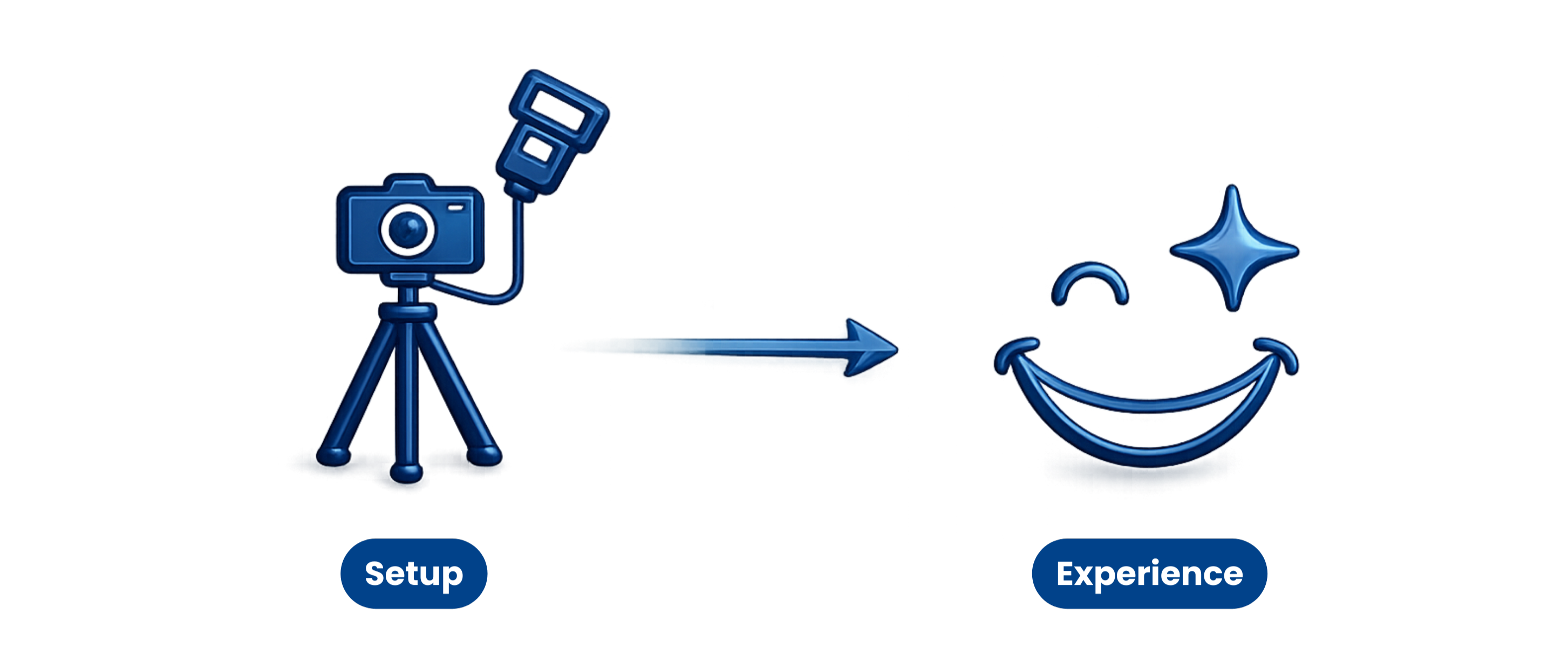
A few years ago, a photo booth was judged largely on how it looked and what it printed.
Today, it’s judged on how it feels.
Guests expect to receive their photos immediately, often while they’re still standing at the booth. Clients expect branding to be consistent across every touchpoint, from the photo itself to how it’s delivered. Event planners expect setups that are fast, reliable, and low-maintenance, especially in high-pressure environments.
Here’s the quiet shift most operators miss:
The value has moved from what you set up to what guests walk away with.
Where many businesses are stuck vs where 2026 leaders are headed
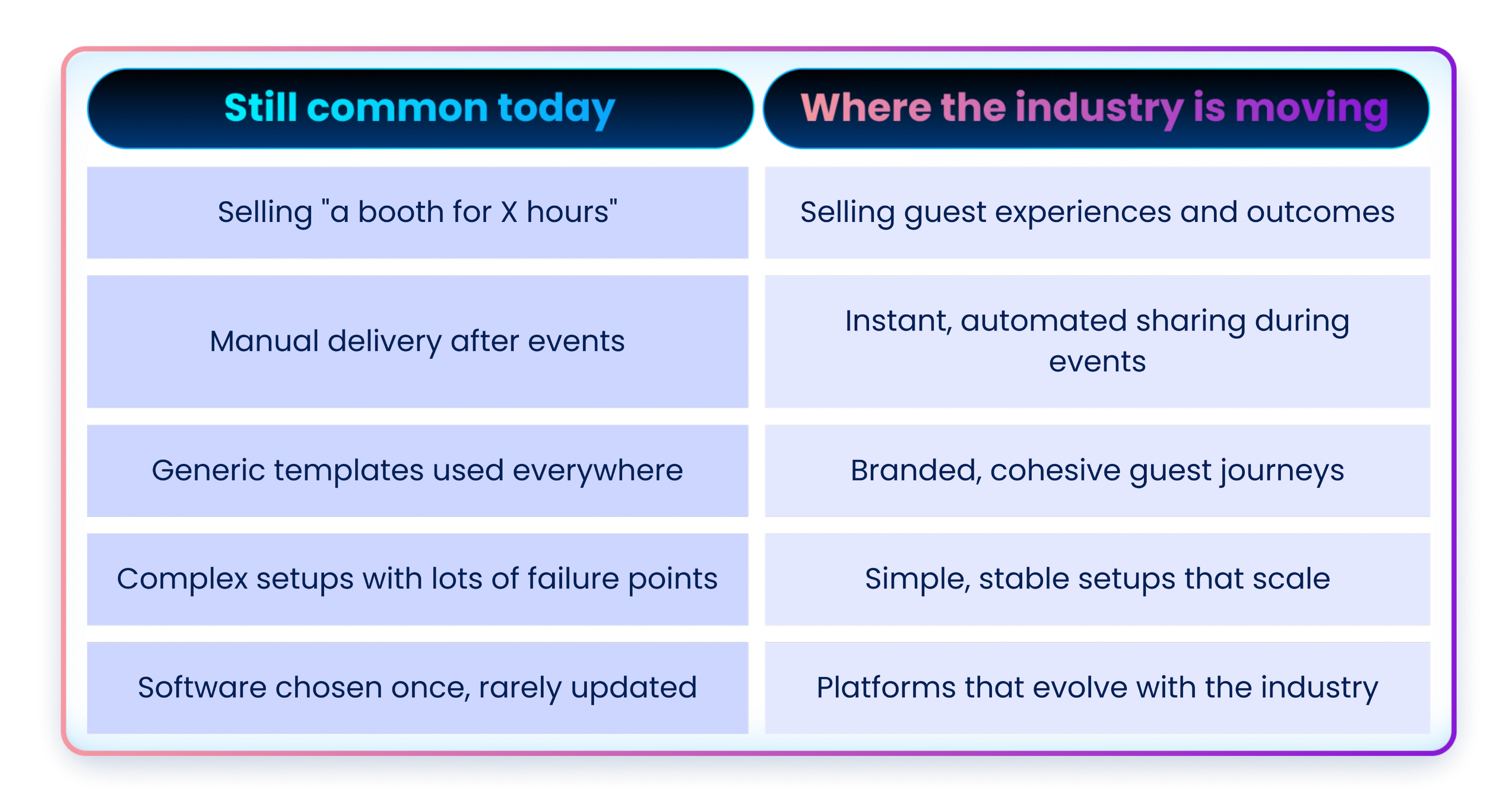
If you recognised your business more in the left column than the right, you’re not alone, but it does explain why some operators are finding it harder to stand out.
The Habits That Are Quietly Holding Businesses Back
Overcomplicating Setups
There was a time when complex setups were seen as a sign of professionalism. More devices, more cables, more steps behind the scenes often meant “higher-end” in the eyes of operators.
In practice, that complexity usually creates the opposite effect.
Overcomplicated setups take longer to deploy, are harder to troubleshoot, and introduce more points of failure during live events. Clients don’t see the effort that goes into them. Guests don’t care how many components are involved. They only notice whether the experience feels smooth or awkward.
Clients never see the complexity. They only feel the friction.
As events become more fast-paced and schedules tighter, simplicity has become a competitive advantage. This is where software starts to matter more than hardware. Platforms that simplify configuration, delivery, and management reduce stress on-site and make it easier to scale without sacrificing consistency.
Selling “Just a Booth”
Another habit that continues to limit growth is selling the service as “a photo booth for X hours.”
When the offering is framed that way, price becomes the main point of comparison. The service feels interchangeable, and there will always be someone willing to undercut.
Clients, however, are not actually buying a booth. They’re buying guest engagement, shareable moments, and an experience that adds energy to their event.
Clients don’t want a booth. They want their guests talking about the experience.
In 2026, the strongest photo booth businesses sell outcomes rather than equipment. They talk about how guests interact with the experience, how content is shared in real time, and how the booth fits into the broader event atmosphere.
This shift becomes much easier when your tools support it. Platforms like Snappic naturally move the conversation away from “a booth” and toward a complete experience by combining capture, delivery, branding, and interaction into one system.
Treating Delivery as an Afterthought
Manual delivery workflows are one of the most common and least visible inefficiencies in the industry.
Exporting files, uploading galleries, sending links, and following up after events can easily become a routine part of operations. Over time, this adds hours of admin work and increases the chance of delays or mistakes.
From a guest’s perspective, delayed delivery feels outdated. From a client’s perspective, it feels unpolished.
If delivery still happens after the event, you’re already behind guest expectations.
By 2026, instant and automated delivery is no longer a premium feature. It’s an expectation. Automated delivery through SMS, email, and branded galleries removes this friction entirely and elevates the experience for everyone involved.
What Modern Operators Are Doubling Down On Instead
Experiences That Feel Branded and Intentional
Branding has moved far beyond placing a logo on a photo.
Clients increasingly expect the entire experience to feel cohesive. The templates, the sharing page, the follow-up — everything should feel like it belongs together. This is especially true for corporate events and brand activations, but it’s becoming just as important for premium private events.
When branding is built into the workflow rather than added manually each time, it becomes scalable. Instead of being a chore, it becomes a clear value driver.
Upsells That Genuinely Improve the Experience
The most effective upsells in 2026 won’t feel like extras. They’ll feel like obvious enhancements.
Instant sharing instead of delayed galleries. Roaming photography alongside a booth. AI-powered transformations guests actually want to share. Personalised outputs that feel tailored rather than generic.
These work because they’re visible to guests and meaningful to clients — without adding unnecessary complexity behind the scenes.
Automation That Makes the Business Easier to Run
Automation isn’t about removing the human element from events. It’s about removing repetition from the business.
When delivery, galleries, and basic guest interactions run automatically, operators gain breathing room. They’re less stressed on-site, more responsive to clients, and better positioned to handle growth without burning out.
Software That Keeps Evolving
One of the most important decisions photo booth businesses will make in 2026 is whether their software is evolving with the industry or quietly falling behind.
Hybrid setups, roaming photography, and AI-driven experiences are no longer experimental ideas. They’re already becoming part of standard event offerings.
Choosing software isn’t a technical decision anymore. It’s a business decision.
Platforms like Snappic focus on continuous improvement, new features, and support that reflects real event conditions — helping operators stay aligned with where the industry is going, not where it’s been.
A Quick Check-In
Be honest with yourself for a moment.
- You still manually send galleries after events
- Your pricing is built around hours, not experience
- Branding feels like extra work instead of a system
- Your setup works… but only if everything goes right
You don’t need to fix everything at once. But noticing these patterns is usually the first step toward meaningful improvement.
The 2026 Takeaway
The photo booth businesses that succeed in 2026 won’t necessarily be the busiest or the cheapest. They’ll be the ones that operate deliberately.
They’ll simplify where others overcomplicate.
They’ll sell experiences rather than equipment.
They’ll automate what doesn’t need constant attention.
Most importantly, they’ll rely on systems that make the business easier to run as it grows.
That’s the real photo booth business playbook for 2026.
FAQs
Q1: What is the photo booth business trend for 2026?
In 2026, photo booth businesses are shifting away from selling standalone booths and toward selling full guest experiences. This includes instant photo delivery, branded sharing, automation, and hybrid setups that combine booths with roaming photography or interactive elements.
Q2: How can photo booth owners stand out in a competitive market?
Photo booth owners stand out by focusing on experience rather than equipment. This means offering branded guest journeys, instant delivery during events, and add-ons that increase engagement and perceived value instead of competing purely on price.
Q3: Why is instant photo delivery important for events?
Guests now expect to receive their photos immediately, often while the event is still happening. Instant delivery increases engagement, encourages sharing, and makes the experience feel modern and professional. Delayed delivery can make an otherwise great experience feel outdated.
Q4: What software do modern photo booth businesses use?
Modern photo booth businesses rely on software that supports instant delivery, branded experiences, automation, and evolving event formats. Platforms like Snappic are designed to handle live event workflows while reducing manual work and supporting business growth.
Q5: How does Snappic help photo booth businesses grow?
Snappic helps photo booth businesses grow by simplifying setup, automating delivery, enabling branded guest experiences, and supporting upsells like roaming photography and AI-powered experiences. This allows operators to sell higher-value packages and scale without increasing operational stress.
If you have any questions we haven’t covered above, our 24/7 support team is always here to help.
New to Snappic? Start your 14-day free trial today!
More from Melissa
Previous Post
What PBX & WPPI 2026 Reveal About Event Photography
See how PBX 2026 and WPPI 2026 reshape event photography. Spot trends in photo booth software, roaming photography, and hybrid event experiences.
Next Post
Best Wedding Photo Booth Software for 2026: How to Book More Premium Clients
Boost bookings this wedding season with Snappic’s wedding photo booth software. Sell premium packages, wow couples, and upsell every wedding photo booth experience